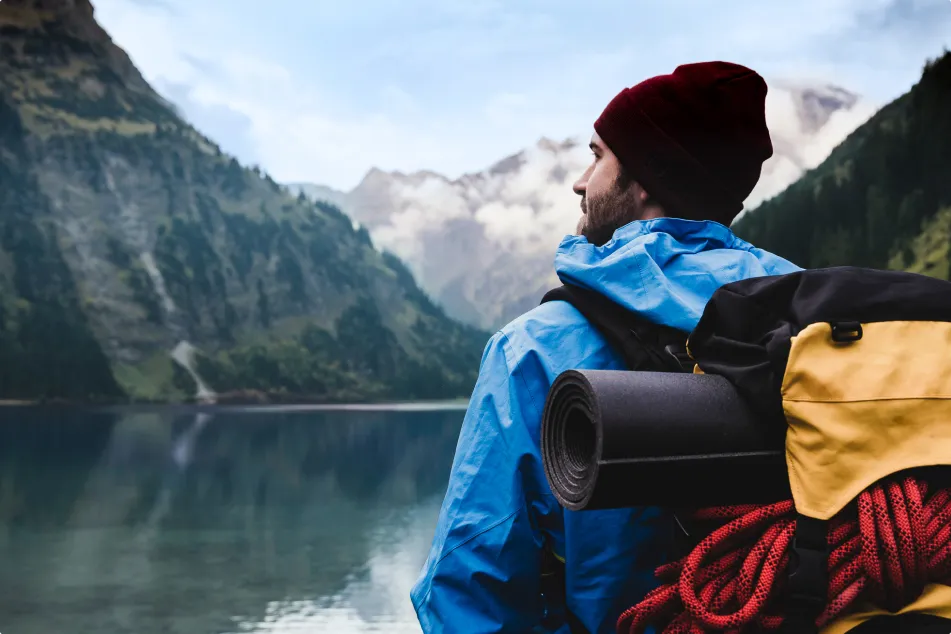
I do not look like the guy on the cover of the REI catalog. I’m 6 feet tall, but most of my clothes are XXL, and that’s not because of my height.
I was never a natural athlete or good at team sports. I liked martial arts but hated running and even walking. I thought traveling on foot was boring. My path to becoming an academic and instructional designer meant I spent little time moving or getting fresh air and sunlight.
Then, in 2016, along with 30 other faculty members, I was laid off from Western Illinois University. I didn’t know what to do with my life. All the time I had spent sitting and reading in libraries and coffee shops had taken its toll on me, and I’d gained weight. I knew whatever I was doing was not working.
Around that time, some friends who’d just gone hiking in Grand Teton National Park talked about their trip, how it helped them reset and see the world anew. I thought, “Well, if my job is telling me to take a hike, I’ll take one — literally.”
1 of 8
What bodies belong outside?
The first time I walked into an outdoor retailer looking for hiking pants in my size, I encountered an unspoken question: Are you the kind of person who shops here?
REI.com carries men's pants up to a 50-inch waist, though most of their retail stores only stock up to 42. That gap reveals the outdoor industry’s imagined “outside guy” demographic.
But the history of mankind tells a different story. For 300,000 years, humans were nomadic people who moved across vast distances, carrying everything they owned on their backs. People of all shapes and sizes did this because they had to, using gear they made themselves.
I’ve hiked in the Blue Ridge Mountains in North Carolina, down along the Rio Grande in Big Bend National Park, around glacial lakes in Alaska, and throughout Utah, where I now live. Realizing that I belong outside has changed the scale of my life. It’s reminded me that movement, attention, and awe are not reserved for a narrow set of bodies or identities.
Here is what I have learned along the way:
2 of 8
The trail is a ‘forcing function.’
If you are on a treadmill and, after 10 minutes, you give in to the voice saying, “Let's quit!” then you have had 10 minutes of movement.
But if you are hiking and decide to stop, you still have to walk back to the trailhead. Ten minutes on a trail means 20 minutes total. That is the power of a forcing function.
3 of 8
Turning back can be wise.
I have turned back on hikes big and small. And I’m glad I did.
I was 95% of the way to the top of Mount St. Helens on a 20- degree day when the wind started blowing me over. The gusts were only getting stronger as I climbed. So I turned around — and that day was still a victory. I hiked for 12 hours, not including breaks.
I have also turned back on weekday morning hikes here in Salt Lake City because I knew pushing farther would leave me brain-dead for work.
4 of 8
The more you know, the less you carry.
The hiking industry will sell you a thousand things you do not need. But the bar for getting started is far lower than retailers want you to believe.
You need boots with traction and a good, comfortable fit. You need water. You need a way to stay warm and dry. You need a charged phone with a signal, or a plan for when you do not have one. You need to tell someone where you are going.
That is the foundation. Everything else is optimization.
5 of 8
By ‘hiking boots,’ I mean …
… boots. Not hiking shoes. Not trail runners.
When you are carrying more weight, the ankle support matters, especially as you increase your miles.
6 of 8
Learn how to lace them.
There are hundreds of ways to lace hiking boots depending on fit and pressure points. YouTube will teach you all of them for free.
Lace your boots slightly tighter than feels natural. If your foot moves around inside the boot, you will pay for it.
Pay attention to hot spots — the places in your boot that start to feel warmer or rubbed raw before a blister shows up. Experienced hikers stop and deal with these immediately rather than powering through. I learned this the hard way in my first year when I got a blister so large, I should’ve made it chip in on rent.
7 of 8
Steer clear of cotton.
When cotton gets wet, it stays wet and pulls heat from your body. In cold or wet conditions, that can be dangerous.
But you do not need to spend $200 on a moisture-wicking base layer. Walmart and most big-and-tall stores carry technical pants and other synthetic athletic apparel and base layers that work fine.
8 of 8
Hike your own hike.
So often, we tell ourselves we need to lose weight before starting an activity, as if our bodies need to be different before they are allowed to move through the world. They don’t.
Don’t wait to live. Start on terrain that doesn’t have a lot of elevation gain if you are not active. When you think it is time to turn back, turn back. If you get home with energy left over, take a walk around the block.
Hike your own hike.
Bill Bryson's A Walk in the Woods and Cheryl Strayed's Wild are two of the most famous hiking memoirs and, in these books, neither hiker finishes the trail they planned. Both are transformed anyway.
Time outside helped steady my nervous system, strengthened my relationships, and gave me access to moments of perspective that are hard to find elsewhere.
Just show up and keep moving. And come back tomorrow to go a little farther.