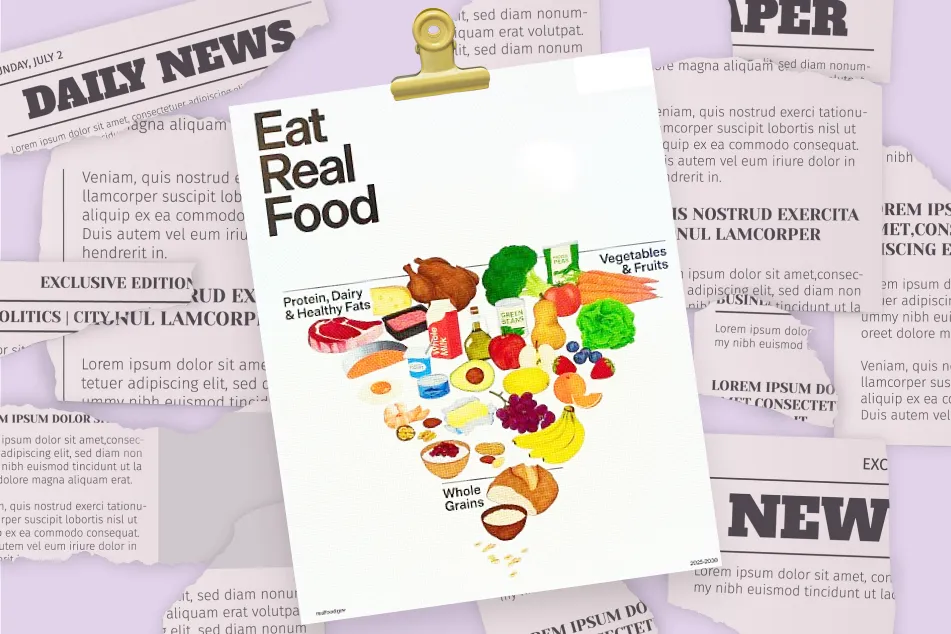
Eat more protein, full-fat dairy, and whole foods. Eat less added sugar and fewer highly processed foods. This is the partly controversial advice reflected in the national dietary guidelines released by the U.S. Department of Health and Human Services (HHS) last week.
The new guidelines, overseen by HHS Secretary Robert F. Kennedy Jr., have attracted a robust nutritional debate. While much of the advice hasn’t changed (you should still eat plenty of fruits, vegetables and whole grains, and try to avoid ultra-processed snacks), some elements have been criticized as confusing, challenging to implement, or contradicting decades’ worth of research.
How This Usually Works, and What’s Different
Updated by law every five years, the Dietary Guidelines for Americans are based on recommendations from a federal advisory committee of independent medical and nutrition experts. Members spend two years examining research and then file a report to the U.S. departments of Agriculture and HHS, which use it to update the guidelines.
That document is usually detailed and thoroughly documented with scientific citations — the 2020-2025 edition stretches 164 pages. Federal agencies use it to shape the National School Lunch Program, Supplemental Nutrition Assistance Program (SNAP), Women, Infants, and Children (WIC), and other nutrition programs. Nutrition educators use it to create clear visual resources for the public, like MyPlate.
At least, that’s the way it’s supposed to happen.
The guidelines released this week run just eight pages, much of which rejects the original advisory committee’s findings but may benefit industries tied to Kennedy’s advisers. The accompanying graphic is an inverted version of the old food pyramid: Meat and cheese have switched places with grains in the widest stripe at the top.
“You can’t just put up a visual like this without background messaging,” said Joan Salge Blake, EdD, RDN, a dietitian and nutrition professor at Boston University and host of the nutrition and health podcast Spot On! “If you look and don’t dive deeper, the visual can give the wrong nutrition information. People are going to use this and say, ‘Oh, I can have as much protein as I want!’”
For some people, eating too much protein can be harmful .
To conduct a deep dive, you’d have to consult a 90-page document that explains the scientific foundation of the guidelines. A second, separate document provides more than 400 pages of appendices.
A Mirror of RFK’s Views
In his public statements, Kennedy has explained his views on the American diet and criticized previous editions of the guidelines — which are intended for health care professionals — as “incomprehensible.” He has said he wanted the guidelines to target two primary issues: What he calls the “war on saturated fats” and the dangers of ultra-processed foods.
Kennedy has long been a proponent of a meat-heavy diet. He’s described his own eating as “mainly meat and then fermented — anything fermented. So, a lot of yogurt, good yogurt without sugar in it. Then, coleslaw and kimchi and all kinds of fermented vegetables.”
The guidelines reflect his beliefs: Recommendations include eating red meat, yogurt with little to no added sugar, and fermented foods.
Meanwhile, research from the National Institutes of Health confirms that long-term consumption of meat is associated with an increased risk of total mortality, cardiovascular disease, colorectal cancer, and type 2 diabetes in both men and women.
Kennedy’s statements on processed foods, like “Ultra-processed foods are driving our chronic disease epidemic," are generally not controversial. Decades of evidence does show that ultra-processed foods have come to dominate our diet at the same time that diet-related chronic diseases have soared. But while the guidelines recommend we avoid “highly processed” foods, they don’t offer much in the way of specifics.
“They said they were going to hold the food industry’s feet to the fire, and a lot of us [nutrition scientists] said that would be cool. So many of us have wanted to do that for so long,” said Christopher Gardner, PhD, Rehnborg Farquhar professor of medicine at Stanford University, who served on the advisory committee. “I’m not seeing that operationalized here at all.”
Disregarding the Science on Saturated Fat
Things get downright confusing when it comes to saturated fat. While the guidelines say you should get no more than 10% of your daily calories from saturated fat, as they have for years, they now also recommend you eat multiple sources of saturated fat: red meat, full-fat dairy, butter, and even beef tallow.
“They said you can have red meat and butter and beef tallow and three servings a day of full-fat dairy,” Gardner said. “You actually can’t do that and stay below 10% saturated fat [per health recommendations].”
Endorsing these foods contradicts extensive research conducted over decades. Saturated fat has been shown to raise the level of LDL (bad) cholesterol in your blood, which may increase the risk of heart disease and stroke. The American Heart Association recommends consuming no more than 6% of daily calories from saturated fat like those found in beef, butter, and cheese.
As a co-leader of the advisory committee’s saturated fat analysis, Gardner and his group read thousands of papers to understand not only the result of eating saturated fat, but also how its replacements might affect your health — what would happen if you opted for a lower-fat cut of meat or reduced-fat cheese vs. choosing beans, peas or lentils. They focused on foods, rather than individual nutrients.
“If you’re a shopper and you’re going to the store, you never write saturated fat and calcium on your shopping list. So we looked at it very much from a consumer perspective,” he said. “I thought, wow, this is so gratifying. This is going to be so much easier to communicate to the public. And then they [HHS] dismiss it and say, well, the saturated fat thing is wrong.”
What This Means for You
The science hasn’t changed, so the dietary advice you receive from health care professionals likely won’t change much, either: Focus on whole foods, including fruits, vegetables, beans, nuts, and whole grains. Watch your intake of sodium, added sugar, and saturated fats. And avoid ultra-processed foods.
If you have a child in school, you may see a federally mandated shift in school lunches toward full-fat dairy, and possibly a different approach to what’s considered “healthy.”
Low-income households may see some changes to what foods are covered in SNAP and WIC programs. Under the Trump administration, 18 states have already adopted SNAP food restriction waivers that exclude things like soft drinks and candy from SNAP coverage on a state-by-state basis, Though no announcements have been made yet, that list could grow in response to the guidelines.
The biggest change may be in how dietary advice is shared, as experts try to reconcile conflicts between what the evidence shows and what the guidelines say.
“What comes out of it will be interesting, what has to happen for communicators,” Blake said. “We’ll have to look at this and say, ‘Wait-wait-wait,’ or say, ‘Yes, this is right.’ We’ll have to look at it and base it on science versus personal preferences.”