The easiest — and cheapest — way to get a prescription for popular GLP-1 weight loss drugs these days is to go online.
Telehealth companies and online pharmacies dispense these medications, which include semaglutide (Ozempic, Wegovy) and tirzepatide (Mounjaro, Zepbound), for hundreds of dollars less than the brand names, often with minimal vetting.
How do they do it? Simple: Their versions are compounded.
The pharmacy gets all the drug parts and combines them to order. The exact formulation may vary, but the active ingredients should be the same as the name brand versions.
A century ago, that’s how all medication was prepared and dispensed. Then big pharmaceutical companies started mass production, and compounding became less common — used only to customize medication in rare, individualized cases.
But now companies are operating in regulatory gray areas to make big money — and it may be at your expense.
Before you sign up with a telehealth company or online pharmacy, here’s what you should know about compounded GLP-1 medications.
1 of 6
Compounded drugs are legal but not FDA-approved.
Brand-name medications — and, when available, their generic counterparts — are verified in the United States by the Food and Drug Administration (FDA) for safety, effectiveness, and quality. The same can’t be said for compounded drugs.
State pharmacy boards regulate traditional compounders, known as 503A, with limited FDA oversight. Larger-scale operations — 503B outsourcing facilities, which produce compounded drugs in bulk — are overseen by the FDA and follow stricter rules, but the drugs still aren’t verified.
During the GLP-1 shortages of the last few years, both types of compounders were allowed to make facsimiles, but that ended in 2025 when supply constraints eased. That means large-scale, routine compounding is no longer permitted — to dispense a compounded GLP-1 today, it must be customized to a specific patient’s needs, at least in theory. Despite this, many online companies may continue to sell compounded versions, though that doesn’t make the practice legal or compliant. Responding to several messages asking for clarification, the Alliance for Pharmacy Compounding issued a “compliance alert” in September stating that compounders may no longer prepare GLP-1 drugs in bulk.
2 of 6
‘Microdoses’ almost always use compounded GLP-1s.
The pharmaceutical companies behind the brand names, including Eli Lilly (Mounjaro, Zepbound) and Novo Nordisk (Ozempic, Wegovy), don’t offer easy-to-use injector pens in the trendy tiny doses that have gained popularity lately — and they haven’t conducted research into microdosing’s effectiveness. Most, if not all, of the companies that offer microdosing are using compounded drugs.
3 of 6
With GLP-1s, accessibility has come at the expense of guardrails.
Usually, increasing access to health care is a good thing. But when it comes to GLP-1s, experts refer to the online marketplace as “the Wild West.” Though the drugs are only FDA-approved to treat type 2 diabetes, obesity, and specific health conditions, the compounded versions are available to almost anyone who can afford the monthly costs. That shifts the burden of finding a safe, reliable pharmacy to you — the patient.
4 of 6
It’s easy to make dosing mistakes.
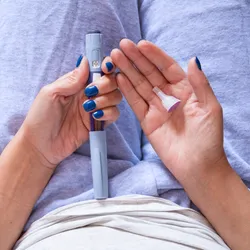
Those single-dose injector pens serve a valuable purpose: They help to ensure you’re getting the right dose, every time. When you use a compounded GLP-1, it typically comes in a multi-dose vial. You have to measure each dose yourself with a syringe — and unless you’ve been trained, you may not pull that off consistently. Some patients have required hospitalization from dosing errors with compounded GLP-1s, according to the FDA.
5 of 6
Cheaper may be riskier.
As of July 31, 2025, the FDA had received more than 1,000 reports of adverse events related to compounded semaglutide and tirzepatide. It has also discovered fraudulent compounded GLP-1s with false information on the label, including the names of pharmacies that don’t exist.
Getting a handle on the situation is proving difficult. In September, the FDA issued more than 100 warning letters to telehealth companies and online compounding pharmacies, including Hims & Hers, a high-profile online provider of GLP-1 medications. The letters pointed to “false and misleading statements,” including promotional materials that boast of the same active ingredients as the brand-name drugs — something that can’t be confirmed without FDA oversight. (As reported by news outlets, the company said it looks forward to “engaging with the FDA.”)
6 of 6
You’re in charge.
It may be the Wild West, but it’s not the Nineteenth Century. Thanks to the same modern technology that makes compounded GLP-1s so readily available — the internet — you have access to information that can keep you safe.
To protect yourself, you should:
- Research enough to know you’re working with a legitimate online pharmacy. Start with the FDA’s BeSafeRx, a public health resource that can help you check whether an online pharmacy is legit.
- Meet with a credentialed, experienced health care provider — ideally, your own. If a telehealth company connects you with one of their providers, Google them.
Get details on the compounding pharmacy itself: Are they licensed to ship to your state? Are they accredited by the Pharmacy Compounding Accreditation Board? Where do they source their ingredients? What’s their track record? Can you speak to one of their licensed pharmacists? If their answers to any of these make you uncomfortable, walk — or click — away.