Your internal circadian clock cycles every 24 hours and tells you when it’s time to fall asleep and wake up based on cues from your external and internal environment like lightness, darkness, and hunger pangs.
Most people’s sleep-wake cycles sync up with their environments, but some do not, resulting in poor sleep that may lead to daytime drowsiness, decreased alertness, and problems with memory and decision-making.
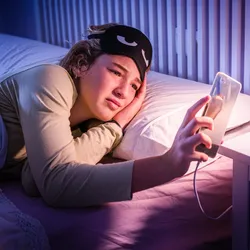
The most common circadian rhythm sleep-wake phase disorder is called delayed sleep phase syndrome (DSPS). With DSPS, your internal body clock is delayed by two or more hours, making you fall asleep and wake up much later than conventional times. People with DSPS might not be able to fall asleep until 4 a.m. and find it hard to wake up until the afternoon.
Circadian rhythm disorders like DSPS can be the temporary result of stress, work, or travel — or they can be more enduring and result from a person’s age, genes, or a medical condition. According to researchers at the National Institutes of Health, once a circadian rhythm disorder interferes with your daily life — leading to tardiness, poor decision making, or dangerous driving, for example — it needs addressing.
To diagnose DSPS, sleep specialists will ask patients detailed questions about their sleep patterns and environment. Treatment typically comprises light exposure therapy, melatonin supplements, and sleep-wake time adjustments (also called chronotherapy) designed to shift a patient’s sleep schedule to an earlier time and maintain that schedule.
Answer the questions below to see if you may be showing signs of DSPS. Share your results with your doctor and learn more about healthy sleep habits here.
This self-test, drafted by Embody editors, is informed by criteria outlined in the Diagnostic and Statistical Manual of Mental Disorders (DSM-5). This self-test is designed to screen for the possibility of delayed sleep phase syndrome, and it is intended for personal use only. This self-test is not intended as a diagnostic tool.
Sleepiness sets in much later (usually more than two hours later) for me than the time most would consider normal.
- a
Strongly Agree
- b
Agree
- c
Unsure
- d
Disagree
- e
Strongly Disagree
I struggle to fall asleep at an earlier hour, even under the right conditions (a dark and quiet room, comfortable temperature, no screen use, etc.)
- a
Strongly Agree
- b
Agree
- c
Unsure
- d
Disagree
- e
Strongly Disagree
Once sleepiness sets in, I am able to fall asleep easily.
- a
Strongly Agree
- b
Agree
- c
Unsure
- d
Disagree
- e
Strongly Disagree
Once I fall asleep, I have no problem staying asleep.
- a
Strongly Agree
- b
Agree
- c
Unsure
- d
Disagree
- e
Strongly Disagree
When I am able to sleep and wake up on my own time, I wake up feeling refreshed.
- a
Strongly Agree
- b
Agree
- c
Unsure
- d
Disagree
- e
Strongly Disagree
Getting up at a “normal” hour is extremely difficult for me. It’s like my body isn’t made for it.
- a
Strongly Agree
- b
Agree
- c
Unsure
- d
Disagree
- e
Strongly Disagree
When I wake up at a “normal” or conventional time, I feel excessively sleepy during the day.
- a
Strongly Agree
- b
Agree
- c
Unsure
- d
Disagree
- e
Strongly Disagree
I experience morning confusion when I wake up at a “normal” time.
- a
Strongly Agree
- b
Agree
- c
Unsure
- d
Disagree
- e
Strongly Disagree
I have problems at work, school, and/or in my social life because of my sleep schedule.
- a
Strongly Agree
- b
Agree
- c
Unsure
- d
Disagree
- e
Strongly Disagree
This questionnaire is not a formal diagnostic tool and is intended for informational purposes only for adults ages 18 and older. Only a trained healthcare professional can provide a medical assessment and personalized treatment plan.
Thank You for Completing the Healthy Living & Weight Management Quiz
Your Score:
The higher your score, the more likely you are to benefit from a conversation with a healthcare provider, nutrition specialist, or wellness professional. Print out these quiz results and share them at an upcoming appointment to learn more about related challenges, treatment options, and/or support strategies.

The Healthy Habits Project
A free weekly course on nutrition, exercise, sleep & the science of habits
By clicking Subscribe, I agree to the WebMD Terms & Conditions & Privacy Policy...