As a population, we are growing weaker — with hazardous consequences.
Only 24% of women in midlife, and 17% of women over 65, meet the recommended guidelines for strength training, according to the CDC. At the same time, women who strength train just three times a week can cut their mortality risk in half. According to one large study of more than 400,000 people, women who do any strength training exercises have a 20% lower risk of death than those who do none.
The benefits to health and longevity are clear; however, strength training remains underutilized or ignored by most women. Why? For decades, messaging around women’s health emphasized cardio above all else. Step classes. Spin classes. Zumba. We came to assume that any good workout must deliver that calorie-burning, heart-pumping feeling you get from aerobics. We left the dumbbell rack at the gym to the men, and that was a mistake.
“When women pick up a barbell for the first time, they feel an efficacy and internal strength that you don’t see with any other exercise,” says Selene Yeager, an NASM certified personal trainer and founder of the Hit Play Not Pause podcast. “The transformation that happens is honestly almost immediate.”
Strength training, also called resistance training, supports bones, helps with weight management, builds muscle, and may even reduce hot flashes in menopause. Here's how:
Less Muscle, More Fat
During menopause, women start to lose muscle mass (the size and volume of muscles) and strength (their ability to generate force). One study found that muscle mass declines in menopause at a rate of about 0.6% a year, adding up to an approximate 12% loss by age 70. Muscle strength decreases even faster, at the rate of 1% a year.
Estrogen is integral to muscle protein formation. As estrogen declines, less new muscle is formed and existing muscle begins to break down. Decreasing estrogen also changes your muscle-to-fat ratio (more fat, less muscle). Low estrogen causes fat stores to shift to your waist, causing more of an apple shape.
“This body type has been associated with medical conditions like insulin resistance,” says Beverly Tchang, MD, associate professor of clinical medicine at Weill Cornell Medical College in New York City. “Strength training is key to preserving that muscle mass and allowing fat loss to happen.”
Less Muscle, More Hot Flashes
Having low muscle mass and high body fat is associated with more severe menopausal symptoms for reasons that are not yet fully understood and likely include a combination of factors. Low estrogen increases insulin resistance, cholesterol, and oxidative stress, or free radicals, which are all thought to exacerbate hot flashes.
Less Muscle, More Fragile Bones
Estrogen protects your bones, so when it dips, you start to lose bone density. Bone thinning can be reduced, however, by weight lifting. Studies show that the stress placed on bones by weight-bearing activity triggers bone cells to rebuild.
How Much Weight Training Do You Need?
Any strength training improves your health. “If you’re doing nothing, do something,” says Yeager.
If you want to make a significant impact on your health, the National Strength and Conditioning Association recommends that adults over 50 do strength training two to three days a week. To build muscle, your mantra should be “lift heavy.” That’s because when muscles are put under stress, it causes microscopic tears in muscle fibers, which triggers your body to repair and rebuild them bigger and stronger. Heavier weights result in more tearing and rebuilding.
If you’re new to strength training, a session or two with a personal trainer can offer guidance on form and help you figure out an approach that addresses your specific needs and takes into account your limitations.
Here’s some general guidance to begin:
- Do up to three sets of 10 to 12 repetitions of a resistance exercise for each muscle group, such as your arms, chest, shoulders, and legs.
- You can use free weights or a machine.
- Choose a weight that is challenging but not impossible for a set of 10 to 12 repetitions.
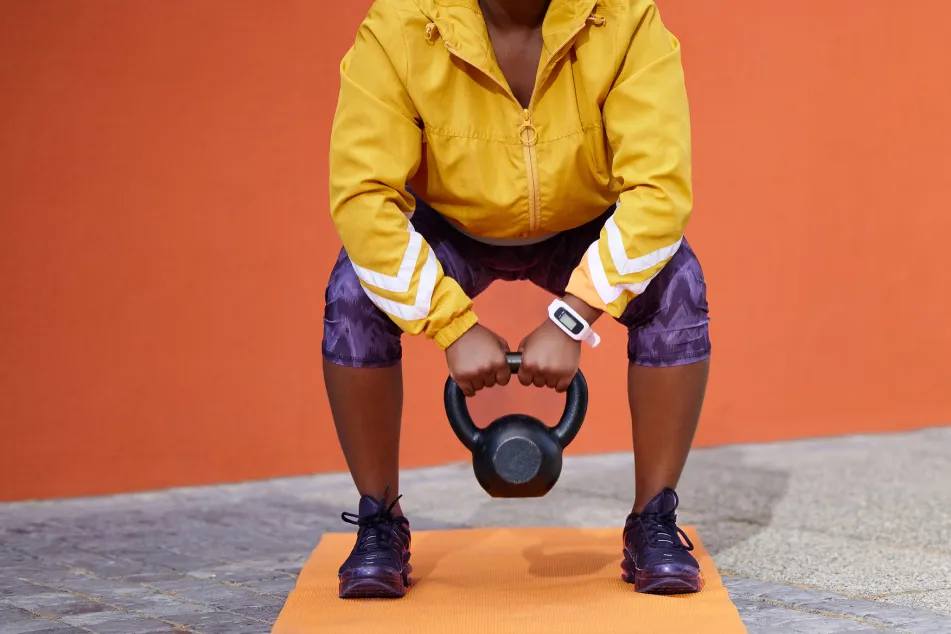
- For multi-joint exercises that use more than one muscle group, like squats, leg and chest presses, and dead lifts (with a barbell), do shorter sets of four to six repetitions with heavier weights.
- As the repetitions become easier, increase the weight.