Self-confidence was not abundant during my childhood. In a family of musicians, I seemed to be the only one without musical talent. Still, I loved listening to music, which provided an escape from a tumultuous household. When I think of my teen years, I think of riding in my friend’s Jeep with the radio blasting, or driving an hour to see the Dave Matthews Band, or dancing in Syracuse clubs and bars.
When I became a mom in my early 20s, my love for music only grew — and so did my insecurities. I was self-conscious when I showed up at a local get-together for new moms in my neighborhood. I didn’t know how I would be perceived or if I would be accepted. Slowly, I made strong friendships, and built lasting connections.
Some of these connections formed around music. One of my new mom friends loved live music as much as I did, and we became concert partners, seeing the Killers, Jason Mraz, Mumford and Sons, and plenty more over the years. But with two young kids at home, seeing live music was relatively rare. Mostly, I listened to music by myself or with my kids, dancing while cooking dinner.
Then, when my kids were 12 and 10 years old, one of my mom friends invited me to join a group exercise event her friend was planning in Prospect Park, not far from where I live. It was called Dancewalk.
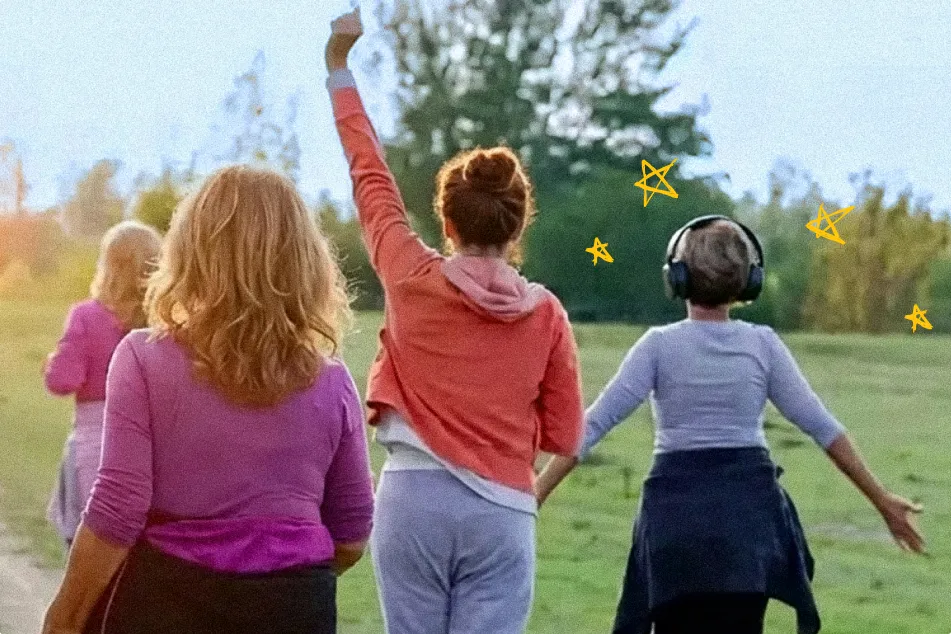
She explained that everyone would gather at a meeting spot in the park. They’d put on their own pair of headphones, listen to their own music — whatever style moved them — and dance as they walked the 3-mile loop around the park.
The idea of being able to listen to my music, uninterrupted, for so long, was a big draw. For those 3 miles, I wouldn’t have to tend to a child needing a snack or a ride someplace, or the thousand other requests moms field every day.
And though I’d never played sports growing up, I liked group exercise more than working out alone. In the past, I’d been a runner and had jogged the Prospect Park loop more times than I could recall. But running was hard on my body and I found myself focusing on how out of breath I was, and how much I wanted to just stop. Working out with others gave me the benefits of exercise, and also was a good way to make friends. Win-win.
I was nervous arriving at that first Dancewalk. It seemed silly. I worried people would be judgmental. But as a mom of a budding teenager, I felt I had to shed that nervousness to show my teen it was OK to pursue your interests and desires despite possible criticism.
That first meeting, it was hard to get into my music. I was aware of the people walking or running on the loop near me and felt embarrassment at what they might think of this “alternative” activity. But being in a group, all of us doing the same thing, slowly quieted that embarrassment.
I dancewalked down the same path I used to run, but this way of moving felt much easier on my body. Slowly, I got inside the music. Even though we moved around the loop fast — almost as fast as my running pace — I wasn’t focused on how tired I was. I took in nature, noticing the changing leaves, and the clouds. I listened to the song “Valerie” by Amy Winehouse, and as I dancewalked by the lake, I heard Winehouse sing, “I look across the water.” It hit so perfectly.
That was nine years ago. I’ve been showing up at Prospect Park most every weekend since.
As the years raced by, and the world felt heavy, Dancewalk was a much-needed release. Soon after I began dancewalking, my oldest started applying to high schools in New York City, which is a stressful process that includes lots of research, tours, auditions, and careful rankings. Allowing myself an hour and a half each week to get out of my head, to shut out the outside noise, dropped my cortisol levels and helped me keep things in perspective. My oldest, who was also feeling the pressure of the process, joined me many weekend mornings for Dancewalk. The funny part is, my teen ended up going to a performing arts high school to study music and now is a vocal major in college. Maybe my love of music is genetic.
I love how Dancewalk can’t really be categorized. It’s an activity done with a group of others, but is also very solitary because everyone listens to different music, moves their body differently, walks at their own pace. Because of this, Dancewalk is freeing.
Dancewalk has taught me about the change that can happen when you commit to a regular practice. In the spring and summer, Dancewalk is crowded because the weather is conducive to outdoor activities. Come late fall and winter, people start dropping out. Winter Dancewalk requires strategic layering; as you warm up, layers come off and need to be tied around your waist in a way that won’t hinder your dance moves. Showing up at the same place in the same park — in winter, spring, summer, or fall, through seasonal changes, through personal changes — helps me reflect on myself and the world around me.
But the true gift of Dancewalk has been my connection with the other dancers, primarily women. After each loop session, we debrief at a grassy triangle near Grand Army Plaza and, in the process, I found we all had a lot in common. Through Dancewalk, I’ve made close friends, honored 50th birthdays, bar mitzvahs, and the deaths of Prince and Bowie. I’ve recently become an empty nester with many fellow dancewalkers.
I started doing Dancewalk for the exercise, but that quickly became a byproduct. The internal change I have experienced since putting myself out by doing something seemingly silly feels immeasurable and so unexpected. It helps me feel more aligned with my true self.