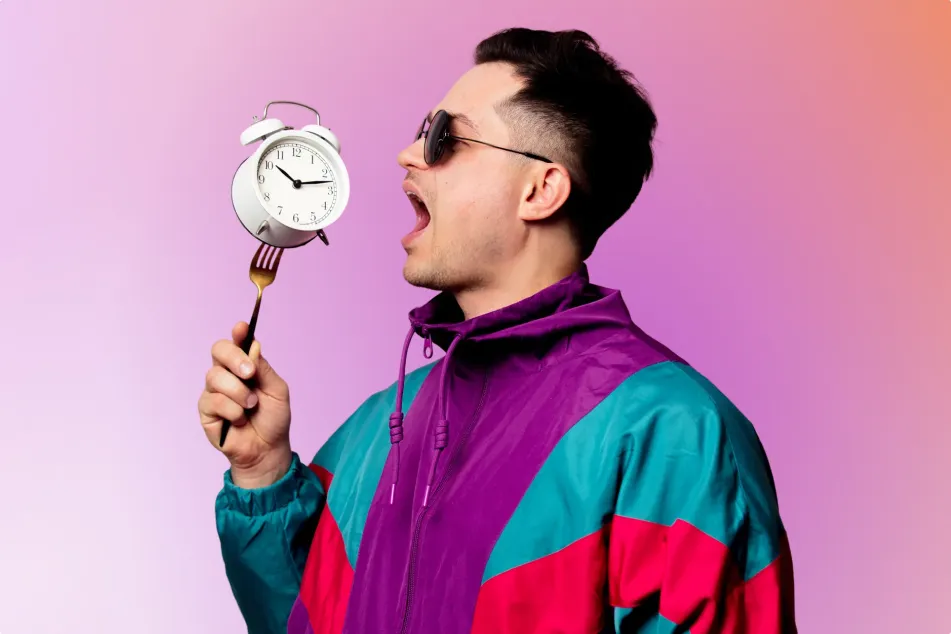
If the siren song of late-night snacks beckons and even hypnotizes you, it may not be a problem of willpower — it may be your circadian clock.
Studies show that eating late relative to that internal clock — not just the wall clock — ramps up appetite, slows calorie burning, and increases fat storage, helping to explain why late-night eating is linked to weight gain and why it seems to affect some people more than others. Each of us has a unique 24-hour internal clock regulated by the brain and influenced by our genes, environment, and behaviors. It tells us when to go to bed and when to wake, making us sleepy at night and keeping us alert during the day, but it also controls processes like digestion and hormone release — helping determine when we feel hungry.
"A calorie is a calorie,” said Frank A.J.L. Scheer, PhD, professor of medicine at Harvard University, at the 2025 World Sleep Congress in Singapore. “The question is, what does the body do with that calorie?"
His work, and the broader field of chrononutrition, suggests that the answer depends on the clock inside us, not just the clock on the wall.
In one study, Scheer and his colleagues tracked 110 participants’ food intake for one week and measured levels of melatonin (the “sleep hormone”). “Biological night” (when the body starts producing melatonin) began around the same clock time for all participants. But those with higher body fat reached their “daily caloric midpoint” — the point when you’ve eaten half your day’s calories — 1.1 hours closer to the time when their bodies started prepping for sleep. They also ate their latest calories closer to that sleep-ready window than the leaner group. An hour’s difference may not seem like a lot, but it could be enough to throw off your metabolism, which has its own circadian rhythm.
"When [we] just used clock time, this whole association [between timing of eating and body fat] fell apart," Scheer said. Translation: Eating in sync with your body’s internal clock may play a role in your weight.
How Circadian Rhythms Affect Obesity Risk
This line of research could lead to more effective weight loss strategies and add another piece to the complex puzzle underlying obesity. Insights could be especially impactful for adolescents, whose eating patterns may persist throughout their adult lives.
In 2025, Scheer teamed up with scientists including Mary A. Carskadon, PhD, a Brown University professor who specializes in teen and young adult sleep. Their goal was to understand how teens’ internal body clocks control how much they eat.
The team brought 51 adolescents into a lab for seven 28-hour sleep-and-wake cycles — without clocks or natural light. Using the 28-hour cycle allowed the researchers to “disentangle” the circadian rhythm from habits tied to clock time. They monitored the teens’ sleep, hunger, calorie intake, activity levels, and circadian phase.
All participants (regardless of body weight) ate more food in the circadian late afternoon and early evening, and less food in the circadian morning — the first-ever demonstration that circadian rhythm directly regulates calorie consumption throughout the day.
Compared to healthy-weight participants, higher-weight teens ate more calories later in the 24-hour circadian and wake cycle, and their calorie consumption appeared less affected by circadian rhythms. So their internal body clock had less pull and kicked in later.
Looking ahead, the results pose new questions: How do internal clocks influence late-eating patterns in those at risk for obesity? Could weight loss or gain affect the body clock-food intake relationship? Or could changes to that relationship affect weight?
For now, the takeaway is this: Next time you’re craving something at bedtime, know that it’s not your fault; it could be your body clock firing off unhelpful hunger signals. Research shows that hunger tends to peak in the “biological evening” and dip in the “biological morning” — understanding that may help you anticipate cravings so you can plan ahead, avoid acting on them, and maintain alignment between when you eat and when your metabolism is most efficient.