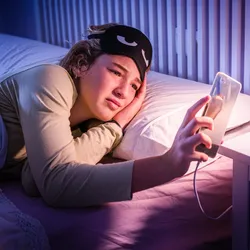
Most of us have heard that nighttime light exposure — from digital screens and other sources — can wreck sleep. But if you’re sleeping fine, you might understandably dismiss the warnings.
Here’s the thing: New research suggests nighttime light can drive weight gain, even without obvious changes in sleep.
"Artificial light at night seems to be a problem," said Kathryn J. Reid, PhD, a professor and sleep medicine researcher at Northwestern University who studies how artificial light exposure patterns shape obesity risk.
Light signals to your brain that it’s daytime, keeping your body in a low-level alert mode, Reid explained at a 2025 sleep medicine conference. With nighttime light exposure, your internal stress response never fully shuts off, creating metabolic chaos that may promote weight gain.
1 of 5
Nighttime Light Activates a Stress Response

In a 2022 study conducted by Reid and colleagues, people sleeping in just 100 lux of light (think dim hallway) showed elevated heart rates throughout the night. The researchers looked at something called heart rate variability, a measure of the variation in time between heartbeats that can be used to gauge the balance between the body’s sympathetic (fight-or-flight) and parasympathetic (rest-and-digest) nervous systems.
In those who slept with lights on, this balance was off. Their stress response remained active, raising heart rate and disrupting their muscles’ response to insulin (the hormone that regulates blood sugar). The finding aligns with a pattern Reid has observed: People with diabetes, hypertension, and obesity consistently show higher artificial light exposure during what would otherwise be their darkest hours.
2 of 5
Nighttime Lights Elevate Blood Sugar
To check the effect on participants’ blood sugar, the researchers used a HOMA-IR test, which analyzes fasting blood samples taken 20 minutes after waking. This provides a snapshot of how well insulin is working. The “lights-on” sleepers saw this measure increase by 15%, indicating insulin resistance (a risk factor for weight gain and diabetes).
Even more revealing were glucose tolerance tests: After participants downed a sugary drink, researchers drew blood samples every 10 to 30 minutes for two hours, measuring glucose (blood sugar) and insulin. Glucose levels were similar whether people slept with lights on or off, but insulin was much higher in those who slept with a light on.
What this means: The bodies of people exposed to bedtime light had to work overtime, pumping out extra insulin, just to keep their blood sugar in a normal range.
The findings align with other research linking nighttime light exposure with weight gain. One study of more than 43,000 women found that those who slept with a TV or light on were 17% more likely to gain 11-plus pounds over five years — even after controlling for diet, exercise, and sleep duration.
3 of 5
Blue Light Is Particularly Bad
Blue artificial light, the kind used to light digital screens, may be especially harmful, according to Jan-Frieder Harmsen, PhD, a researcher with Aachen University in Germany and Maastricht University in the Netherlands. Harmsen’s research has linked blue light with poor blood sugar control. "This effect was really blue-light dependent," Harmsen said at the conference. With red light, the negative effect disappeared.
4 of 5
Flipping the Switch on Brown Fat
Research in mice points to another possible explanation: artificial light appears to “turn off” brown fat (the calorie-burning fat that keeps you warm).
To see if this happens in people, researchers gave volunteers glucose tolerance tests at different room temperatures. At 19 C (cool enough to activate brown fat to help generate body heat), artificial light exposure — no matter the time of day — significantly worsened glucose processing. But at a warmer 29 C — when brown fat stays inactive because no extra heat is needed — artificial light had no such effect.
5 of 5
The Timing Effect Works Both Ways
Reid's earlier research using wrist-worn light monitors revealed that people who got more morning light above 500 lux tended to have lower body mass indexes. A window-lit room can be 500-1,000 lux, but interior spaces can drop to 100-300 lux or even as low as 25-50 lux.
Harmsen's latest research, which is being prepared for publication, found this: When people with type 2 diabetes were studied over a 24-hour period, those exposed to natural daylight cycles (up to 2,000 lux during daytime, and darkness at night) versus constant artificial light around the clock (300 lux) showed better blood sugar control and increased fat burning, especially around midday.
Biopsies and gene expression analyses revealed that the natural light also synchronized their muscles' internal clocks, helping regulate appetite and metabolism.
Other research shows that brighter mornings and darker nights may help promote cardiometabolic health, according to a 2025 study review.
While these findings are still preliminary, you can try this simple approach now: Get more bright light (ideally natural sunlight) in the morning and keep light below 100 lux in the three hours prior to bedtime, Reid suggests. Sleep in as dark a room as possible.