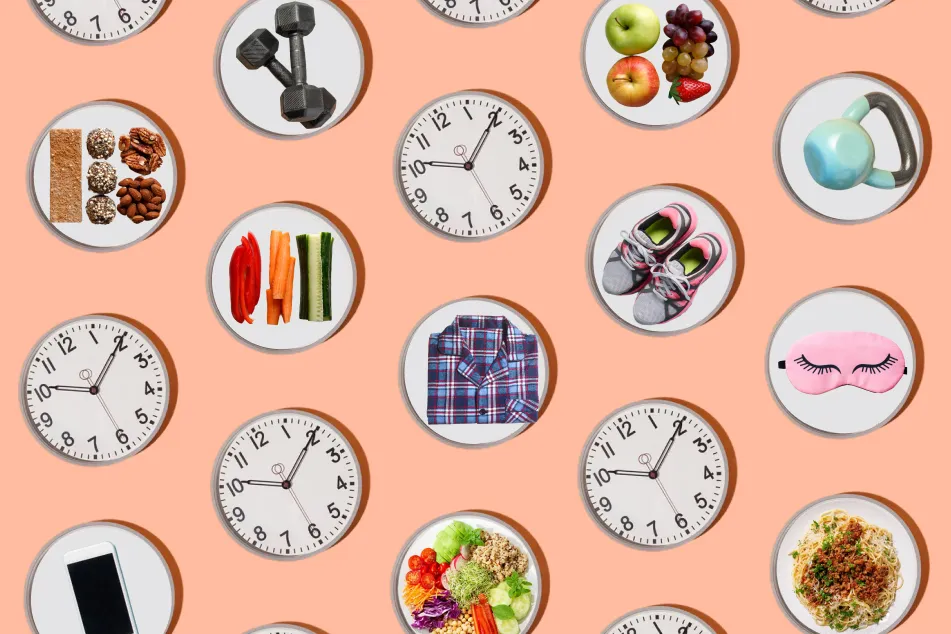
When you eat is as important as what you eat, according to circadian rhythm researcher Satchin Panda, PhD, who writes, “Timing is everything.”
Dr. Panda began researching the effects of circadian rhythm on health decades ago. In his book The Circadian Code: Lose Weight, Supercharge Your Energy, and Transform Your Health from Morning to Midnight, he explains how to live in sync with your body’s internal clocks, which reside in every cell.
“The clocks in different organs work like an orchestra to create three major rhythms that form the essential foundations of health – sleep, nutrition, and activity,” Dr. Panda writes. “These rhythms are entirely interrelated and are also under our control. When they all work perfectly, we have ideal health.”
While there is no magic schedule for everyone, Dr. Panda encourages everyone to follow a few universal rules for making the most of your daily routines.
1 of 12
Breakfast
Breakfast is the most important meal of the day because it tells your body that it’s time to connect with the outside world. “The first bite of food signals the start of the day for the rest of the clocks in your body,” Dr. Panda writes.
Have breakfast shortly after you wake up, and make sure it’s hearty. “If your breakfast is substantial enough, then you’ll probably feel full for the next four to six hours,” he writes. His breakfast of choice? A combination of oatmeal, cottage cheese, almond powder, and cranberries.
Dr. Panda recommends consuming all of your daily calories in the 8 to 12 hours following breakfast, then fasting for the following 12 to 16 hours. Time-Restricted Eating (TRE), a form of intermittent fasting, can “help reduce weight, improve glucose control, and maintain heart health,” he writes.
“By consolidating your meals, you naturally reduce your caloric intake,” Dr. Panda continues. “And when you eliminate late-night eating, you’ll automatically be setting your body up for a better, more circadian digestive process and, ultimately, better sleep.”
2 of 12
Lunch
At midday, Dr. Panda recommends eating something light, like soup or salad, and keeping lunch breaks short so they don’t interrupt the day’s optimal work and learning times.
“Between the hours of 10 a.m. and 3 p.m., your brain is performing at its peak,” he writes. It’s a time when “your attention, working memory, assessment, and mood are at their highest levels.” Take advantage of that time by focusing on tasks that demand the most from your brain, he says.
“Long lunches work in opposition to your circadian rhythm,” he writes. Heavy ones do too. “If you have a heavy lunch, you are more likely to feel sleepy for up to two hours afterward.”
3 of 12
Snacks
Still feeling sleepy after lunch? Try drinking a glass of water or snacking on something healthy like a piece of fruit or a handful of nuts instead of something sweet. “Unhealthy sugary treats will boost your energy for only a very short amount of time and will ease your hunger only in the short term,” Dr. Panda writes.
4 of 12
Dinner
“After breakfast, dinner is the second most important meal to align with your circadian rhythm, as it signals the end of your eating,” writes Dr. Panda.
If your goal is to lose weight, consider eating breakfast earlier in the day so you can eat dinner earlier too. Or reduce your window for daytime eating from 12 hours to 10 or eight. “One study [we looked at] found that people who delayed dinnertime did not see the same extent of weight loss as people who ate their dinner early,” he writes.
Be even more consistent with your eating routines by having your meals and snacks at the same time each day, even on the weekends. For example, if you have breakfast every day at 8 a.m., and follow a 12-hour TRE schedule, finish your dinner by 8 p.m. that evening. Then wake up to breakfast again at 8 a.m., and so on.
Ending the day’s caloric consumption with dinner means closing your kitchen off to any and all late-night snacking, which may be challenging, given that “30 percent of people’s daily caloric intake is at night,” Panda writes.
5 of 12
Caffeine
It’s fine to start your day with a cup of coffee or two. But know that it counts as breaking your overnight fast, even if you have it without food.
Know, too, that caffeine can rev you up temporarily without making up for any sleep deficit you might have. “Drinking coffee is one of the most difficult habits to get in alignment with your circadian code because it directly affects sleep,” Dr. Panda writes.
To keep caffeine consumption from creating sleep challenges for you at night, relegate it to the morning hours. “Coffee stays in your system for up to 10 hours,” Dr. Panda writes. “That’s why the conventional wisdom is to avoid coffee past noon.”
6 of 12
Sleep
Sleep at least seven hours every night, and try to go to bed and wake up around the same time every day, even on weekends and holidays.
What’s the best bedtime? Dr. Panda recommends going to bed three hours or more after your last meal, leaving yourself enough time to settle down in bed, screen-free, and prepare for a night of restorative sleep. His bedtime of choice? 10:30 p.m., unless he’s traveling for work, which can easily throw off his schedule.
“Sometimes good enough has to do,” he writes. “If I can’t exercise, I make sure to hold fast to my TRE. If I eat a late dinner, I still try to give my stomach at least 12 to 13 hours rest before the next meal. If I go to sleep late, I make sure to exercise the next day.”
The primary goal: Wake up feeling rested and alert each morning. “If you need an alarm to wake up, and you’re feeling foggy or sleepy, then it’s likely that you did not get enough sleep,” Dr. Panda writes.
7 of 12
Naps
If your nighttime sleep falls short and you fail to get the recommended seven hours, daytime napping can help compensate. “A nap during the day is one way to repay your sleep debt,” Dr. Panda writes.
It’s important to keep naps short, however. “The longer you sleep in the afternoon, the further you may push your nighttime sleep, making it difficult to fall asleep when you want to later that night,” he adds.
8 of 12
Hydration
Dr. Panda suggests having a glass of water every hour or two during the day to stay hydrated. “Your body needs a lot of water,” he writes. “Especially if you work in a dry environment like an air-conditioned office building.”
What about drinking water at night? “If you wake up in the middle of the night feeling thirsty, go ahead and drink water,” Panda writes. “I’ve found that if I don’t drink water then, I will stay awake.” Unlike drinking a cup of coffee, having water doesn’t count as breaking your fast.
9 of 12
Afternoon Exercise
“Exercise has a circadian effect, improving sleep and mood. It is one of the best medicines,” Dr. Panda writes. When is the best time for it? Late afternoon, claims Dr. Panda. “If you are aiming to get maximum benefit from exercise with minimum injury, afternoon is the best time to exercise,” he writes.
Here’s why: “Exercising between 3 p.m. and dinnertime is when muscle tone begins to rise, so it’s the best time for strength training, including weightlifting or vigorous exercise like intense indoor cycling,” he continues. “High intensity workouts followed by a protein-rich dinner will help repair muscle, build muscle mass, and promote recovery.”
It can also reduce appetite. “Afternoon exercise not only helps burn some calories, it can also help reduce hunger at dinnertime, so you may eat less,” he writes.
10 of 12
Morning Exercise
The second best option is to exercise in the morning, especially if you do some kind of aerobic activity outdoors. “A brisk walk, run, swim or cycle, or any outdoor activity in the presence of daylight is an excellent way to synchronize the brain clock,” Dr. Panda writes. “Going outside to exercise even before sunrise gives you access to enough light to fire up your brain.”
“If you exercise in a gym in the morning, don’t choose the darkest corner of the room. Instead, find a spot that is next to a glass window or under bright lights,” he writes.
11 of 12
Evening Exercise
Dr. Panda’s least favorite time for exercise is evening, “because it delays the nightly rise of melatonin and increases body temperature and heart rate, which might interfere with sleep,” he writes. “You may be resetting your clock by sending a signal that it’s earlier in the day.”
Some exercise is better than none, however. “If you cannot exercise in the morning or afternoon, evening exercise is better than nothing,” he writes. Opt for mild activity after dinner, like an evening walk. If you do hit the treadmill or go to the gym at night, “do it away from bright lights,” he writes.
12 of 12
Medication
If you’re on medication, take it per your doctor’s orders, but pay attention to timing because “some meds actually work better when they’re taken in the morning or at the end of the day,” Dr. Panda writes.
One of the main focuses of Dr Panda's research is the impact of medication timing on health outcomes. His current work suggests that hundreds of existing drugs may work better if they are administered at certain times of the day or night.
For example: “Cancer treatment research is strongly invested in understanding the circadian code and, in our lab, we are working on ways to connect the two,” he writes. “Once the causal connection between circadian rhythm and better cancer outcomes becomes widely acknowledged and accepted, doctors will shift their schedules to optimize for best outcomes.”
“Talk to your doctors to see whether your current schedule is optimizing the outcome,” Dr. Panda writes.